EASM
Automated Pentest (PTaaS)
An attacker's reconnaissance, automated and replayed continuously without taking prod down.
An attacker doesn't test your surface once a year. The automated pentest replays their reconnaissance continuously: every exposed asset goes through the checks that apply to it (the engine holds more than 7,800), CVEs are correlated by banner and version, then prioritised with CISA KEV (flaws with confirmed exploitation in the wild) and EPSS (the probability of being exploited within 30 days). Non-intrusive by design, adjustable from 1 to 1000 req/s, no exploitation replayed. It doesn't replace a human pentester.
- checks in the engine
- 7,800+
- per-host rate, production-safe
- 1 to 1000 req/s
- replayed continuously, not a yearly audit
- 24/7
Features
What automated pentesting replays on your scope.
More than 7,800 checks on every pass
TLS, HTTP headers, DNS and email (SPF/DKIM/DMARC), secret and Git repo exposure, open cloud buckets, admin interfaces, CMS and frameworks. Every exposed asset runs through the same battery of checks as an attacker's reconnaissance, on every scan, without you writing a single rule.
CVE correlation by banner and version
Detected versions and banners are matched against known CVEs, with strict matching to limit false positives. You don't get a dump of the entire CVE catalogue: only what actually matches the service as it responds on the network.
Prioritisation by real exploitability
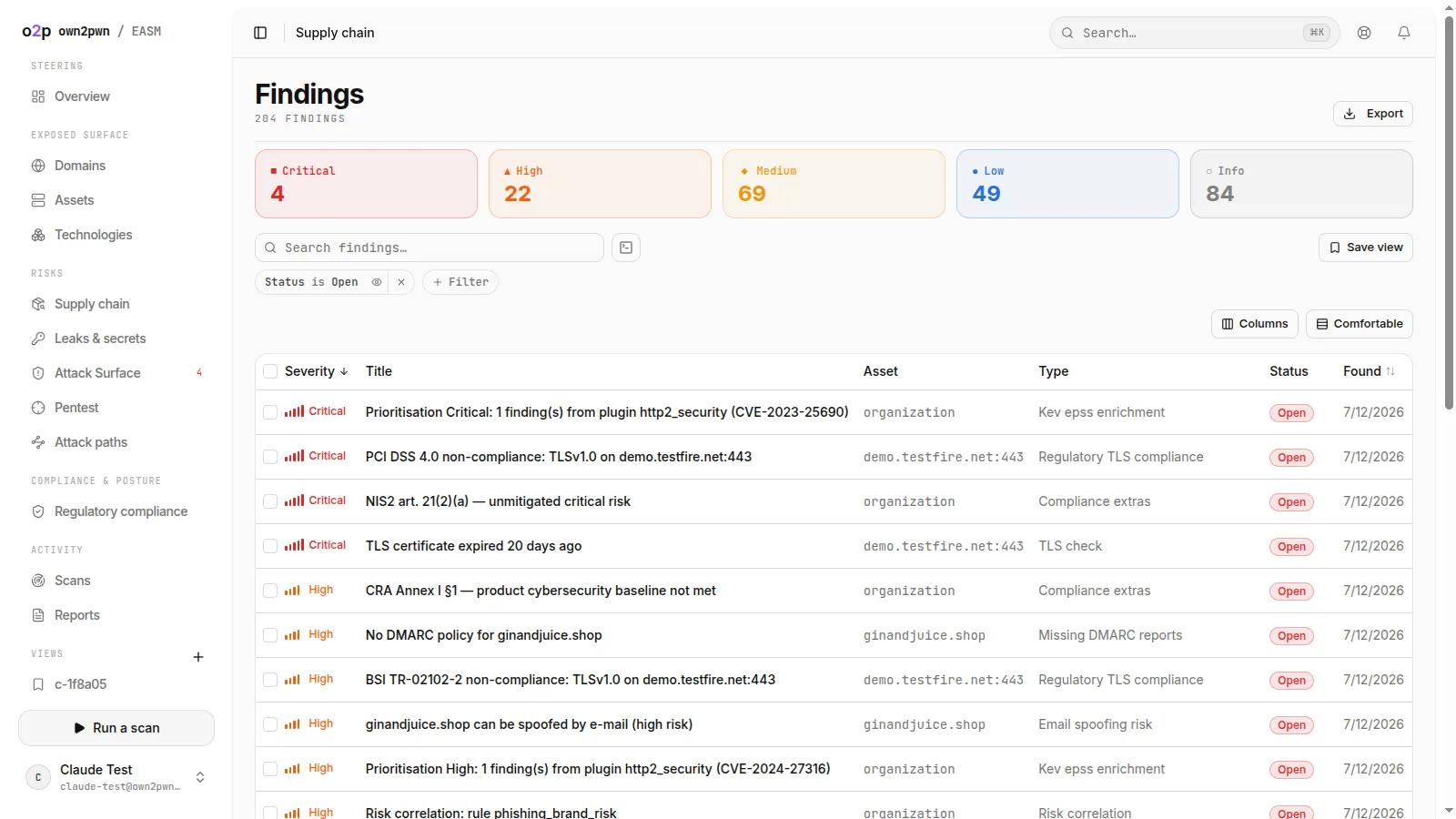
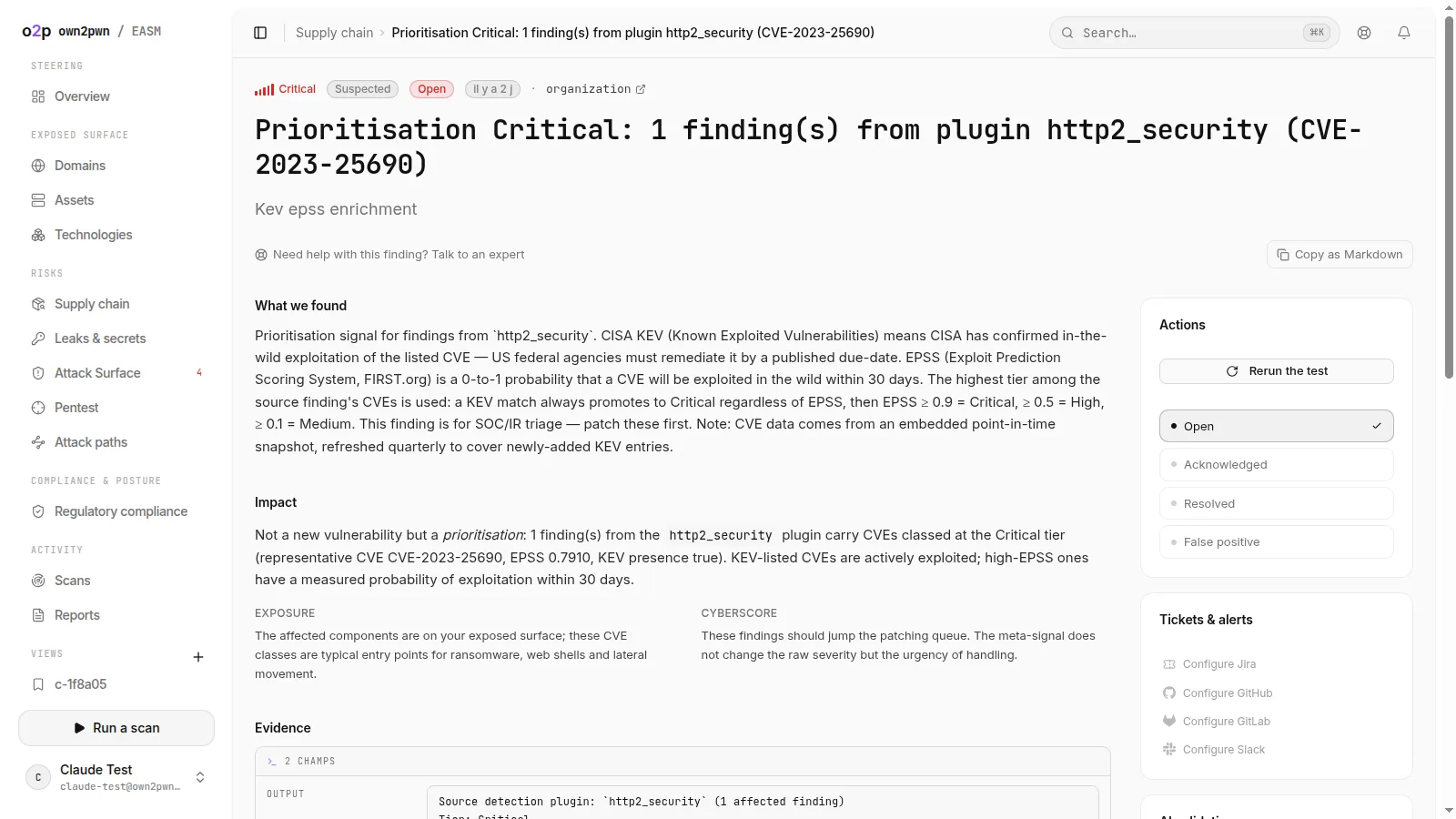
300 findings are useless without an order of treatment. Prioritisation draws on CISA KEV (what is actively exploited in the wild) and EPSS scores (probability of exploitation): the exposed admin console ranks above the ordinary service on 443. You handle what matters first.
Non-intrusive, production-safe
No exploitation replayed, no destructive payload, redirects disabled, three-layer anti-SSRF guard, per-host rate capped from 1 to 1000 req/s. The test runs on production without a maintenance window: you add it to your perimeter without coordinating with the ops team.
Automated pentest pricing.
Discovery
€0
- Automated Pentest module included in the EASM offering
- In plain terms: the perimeter of a single domain name, 25 exposed assets at most.
- 10 scans / mo
- Multi-source discovery + more than 7,800 security checks
- CVE correlation and prioritisation by real exploitability
- 2 AI-native validations / mo
- Email alerts, 1 user
- Free, no time limit and no credit card
Pro
€99 / mo
- In plain terms: 5 domain names, 250 tracked exposed assets, 5 people on the account.
- 100 scans / mo
- 30 AI-native validations / mo
- HMAC-signed webhooks (Slack, Teams, Discord, PagerDuty)
- Jira, GitHub, GitLab, Slack integrations
- PDF and CSV exports, API access (5 keys)
For businesses only, a company identifier is asked at the next step.
Business
€299 / mo
- In plain terms: 15 domain names, 1,000 tracked exposed assets, no cap on scans.
- 100 AI-native validations / mo
- SSO, RBAC and role management
- SIEM connector, custom integrations
- Email support, prioritised handling
For businesses only, a company identifier is asked at the next step.
Enterprise
On request
- In plain terms: the perimeter you set in the contract, no cap on domains or validations.
- SSO / SAML, SCIM provisioning
- Enhanced AI validation (extended reasoning)
- GDPR-compliant DPA, master agreement and NIS2 guidance
- A single point of contact: the pentester who runs it
VAT not applicable (art. 293 B of the French tax code)
How it works
From setup to the first alert.
- 01
You enter a domain
A single root domain name in, for example acme.com. No agent to install, no IP range to provide, no cloud access to connect. The scan starts right away and stays bounded to the domains you declare: no reckless attribution to assets that aren't yours.
- 02
More than 7,800 checks, applied asset by asset
On every exposed asset, the detection battery fires: TLS, HTTP headers, DNS and email, secret exposure, cloud misconfig, service fingerprints, CVEs by banner and version. It's the reconnaissance an attacker would run by hand, executed at scale and hands-off. The rate is capped per host (1 to 1000 req/s), redirects are cut, the anti-SSRF guard is active: nothing is exploited, nothing is broken.
- 03
Correlation, dedup and prioritisation
Detected vulnerabilities are matched against the CVE catalogue by banner and version, deduplicated, then prioritised with CISA KEV and EPSS. The graph links assets and findings to reconstruct attack paths and compute a blast radius. You get a list ordered by real exploitability, not a raw export where the exposed admin console drowns under a hundred cosmetic findings.
- 04
Replayed continuously, alert on the first change
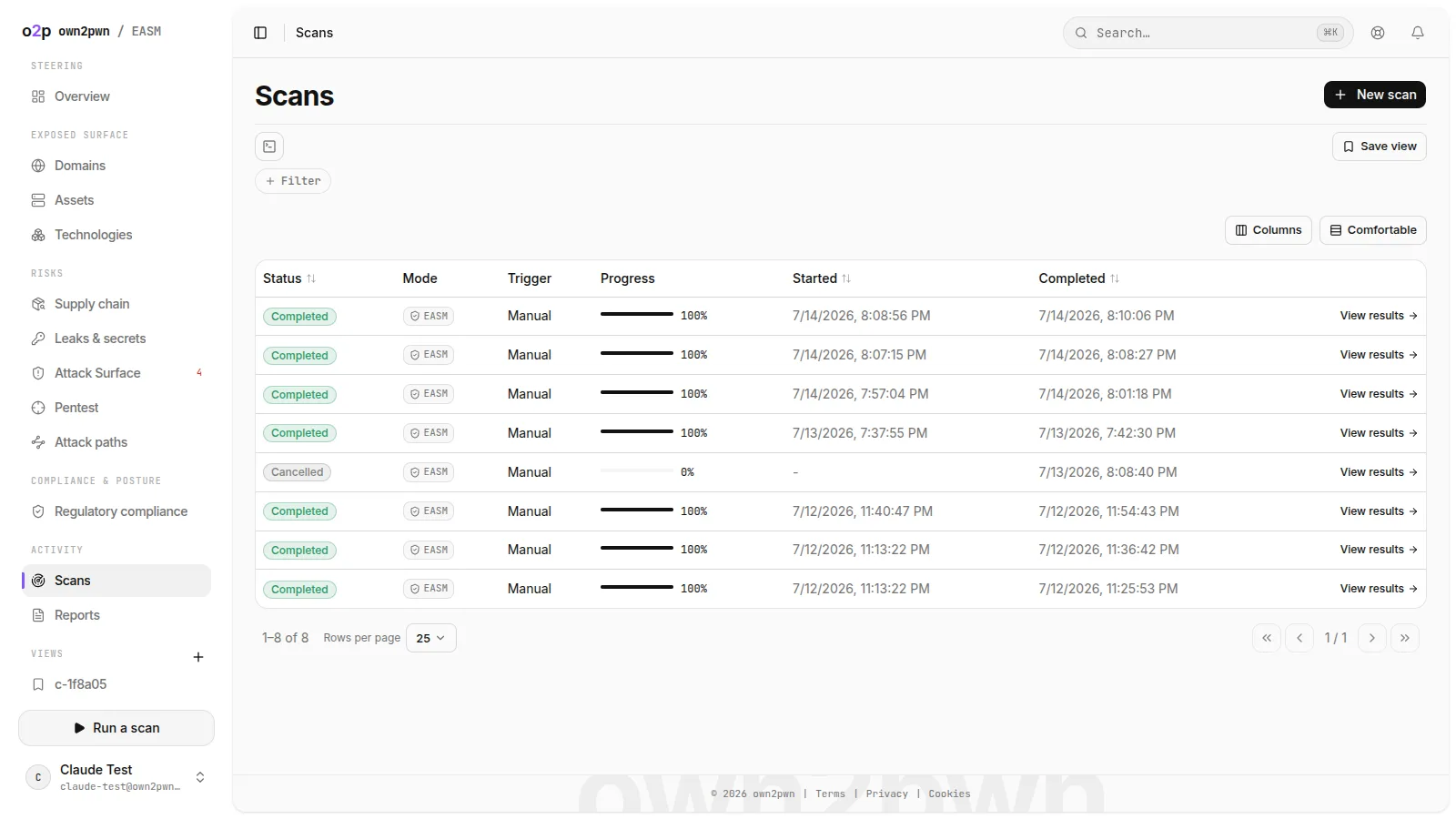
Scans run periodically and on demand, with change detection: a new CVE on an exposed service, a port that opens, a finding that appears or is resolved. The alert lands the same day in Slack, Teams, Jira, GitHub, GitLab, PagerDuty or an HMAC-signed webhook.
Benefits
What automated validation changes in your triage.
An attacker's reconnaissance, on a loop
A human pentest photographs your security at a single point in time. The next day, a deploy puts a CVE back online and the photo is stale. The automated pentest replays the reconnaissance and detection part of an attacker continuously: the checks that apply to each exposed asset (more than 7,800 in total) run again on every scan. The subdomain that exposes an admin console after an update, the service whose version becomes vulnerable to a CVE published yesterday, the bucket left open by mistake: they surface on the next pass, not at the next yearly audit.
Triaged noise, not a CVE dump
Throwing 300 findings over the wall with no order of treatment just moves the problem onto your team. Every exposed service is correlated to CVEs by banner and version, with strict matching to cut false positives, then prioritised with CISA KEV and EPSS: what is actively exploited goes ahead of the theoretical. The attack graph links assets together and computes a blast radius per finding, to see which exposure actually leads somewhere. We don't promise zero false positives. We save you the triage.
A test that doesn't take prod down
The reason many teams only test once a year is fear of breaking something. The automated pentest removes that brake: no exploitation replayed, redirects disabled, three-layer anti-SSRF guard, rate adjustable from 1 to 1000 req/s per host. You add it to your perimeter without negotiating a maintenance window. A single root domain in, no agent to install, no cloud access to connect. Data hosted in the EU, under European law, designed by an OSWE-certified pentester.
Overview
The platform in pictures.
Why own2pwn
Why this is neither a vulnerability scanner nor a human pentest.
Automated is not a human pentester
The automated pentest replays an attacker's reconnaissance and detection at scale: it finds, correlates and prioritises, without ever exploiting for real. It doesn't replace the judgement of a human who chains minor vulnerabilities into a full compromise, tests business logic or writes a bespoke attack scenario. That's our pentests, a separate offering run by an OSWE-certified pentester. The automated test covers the surface continuously; the human goes deep on what deserves it.
Designed by an OSWE-certified pentester
The detection logic follows what an attacker enumerates first, not a generic checklist copied from a framework. Prioritisation reflects real exploitability: an exposed admin console ranks ahead of a high CVSS hidden behind a WAF.
Production-safe, by design
No exploitation replayed, three-layer anti-SSRF guard, rate adjustable from 1 to 1000 req/s per host, redirects disabled. The test slots into your perimeter without coordinating a maintenance window with the ops team. That's what lets you replay it continuously instead of waiting for the yearly slot where everyone holds their breath.
AI to triage, not to chat
No chatbot. AI is used to rank what more than 7,800 checks report by real risk: CVE correlation, CISA KEV and EPSS prioritisation, deduplication, attack-path reconstruction. Optional and quota-limited, an AI-native validation (the AI-Native Pentest module) tries to confirm the exploitability of a critical finding inside an ephemeral sandbox. It is bounded AI, not a human, and we don't promise zero false positives.
Frequently asked questions
Your questions about automated pentesting.
How is this different from a real human pentest?
How is it different from a classic vulnerability scanner?
Is the scan intrusive? Can it break my production?
How often is my perimeter tested?
How do you limit false positives?
Does it cover cloud assets (AWS, Azure, GCP)?
Is it billed on top of EASM?
Where is my data hosted?
Is there a minimum term, and how do I cancel?
Do I need a credit card for the free plan?
How long between payment and actual access?
Can I change plan mid-subscription?
Are findings linked together, or surfaced in bulk?
Go further
The NIS2 directive and Article 21
Who is in scope, the 10 Article 21 measures, and why an inventory of what you expose underpins them.
Read →Finding exposed shadow IT
Tracking down the exposed assets nobody manages.
Read →Comparing EASM platforms
The criteria grid to pick between the EASM tools on the market.
Read →Asset discovery in practice
Subdomain enumeration, ASN, ports and cloud assets to map your surface.
Read →Want findings sorted by exploitability?
The module runs on a verified domain. For a hands-on engagement, a pentester replies within 24 hours.