EASM · Web pentest · AI AppSec
Your breach already exists.The only question is who sees it first.We do.
AI maps and monitors your entire attack surface around the clock. When a pentester runs an engagement, they exploit and prove every finding by hand. You get a prioritised list, with the proof and the fix.
Your attack surface grows every day. Your audits, once a year.
Between the cloud, forgotten subdomains and AI-generated code, your attack surface grows faster than your means to test it. The gap gets paid for: in an incident, or at the next NIS2 check.
EASM
Your external attack surface shifts every day.
Cloud, SaaS, subdomains, certificates, shadow IT. A yearly pentest describes a perimeter that no longer exists the next morning. Discovering exposed assets has to run continuously, not one week a year.
AI APPSEC
You ship code faster than you audit it.
A large chunk of code now starts from an AI, bugs included. Security debt piles up between two quarterly audits. Running SAST, SCA, secrets and IaC once a quarter no longer keeps pace with the merges.
NIS2 · DORA
With NIS2 and DORA, testing your exposure becomes a legal duty.
Assessing risk, testing your security and proving you fix it are now written into law. A report filed in a drawer won't survive an audit: you need proof, dated and repeatable.
Product · EASM
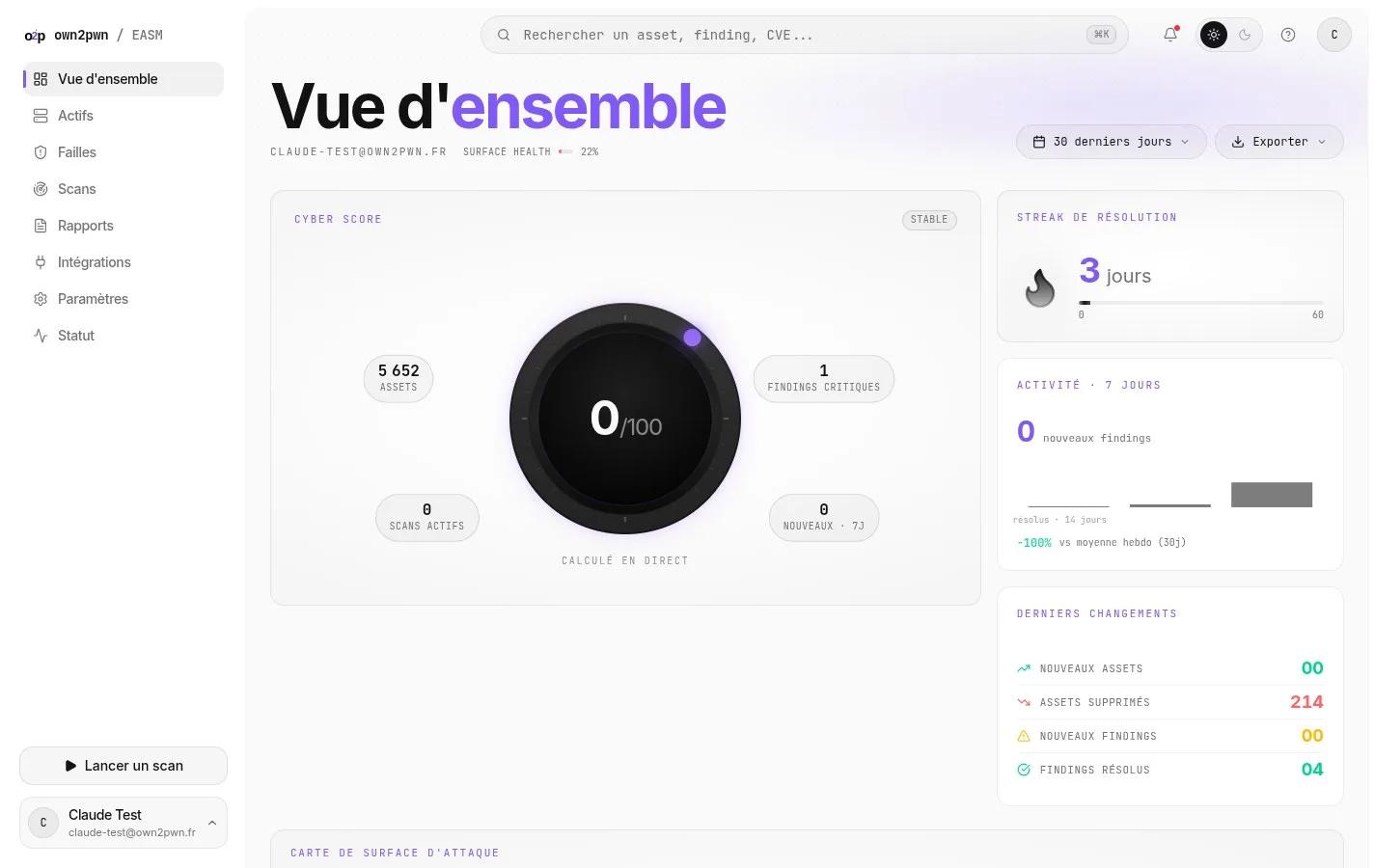
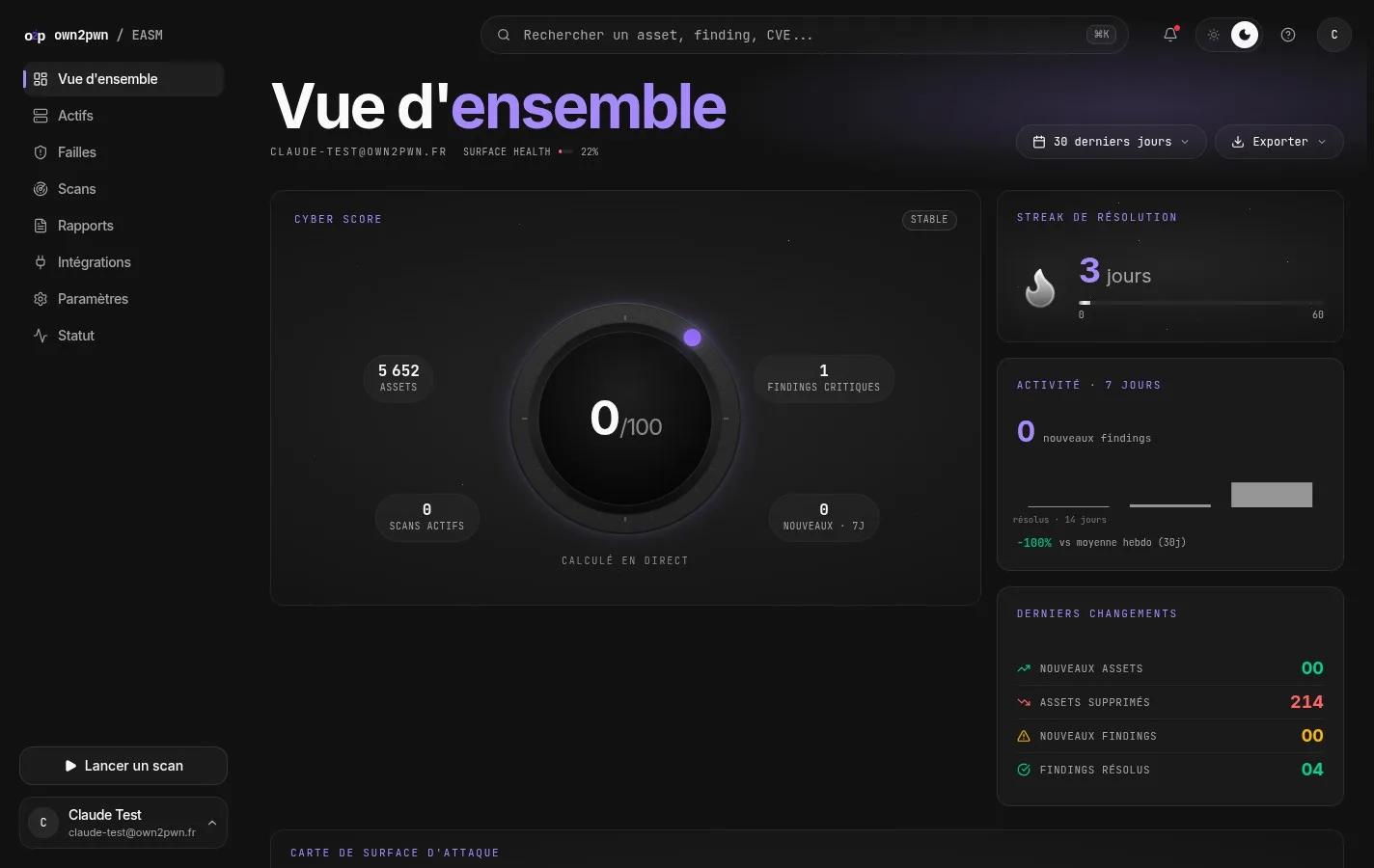
The external attack surface the attacker already sees
A scanner tests what you declare to it. We start from a single domain and pull up everything else: forgotten subdomains, staging left open, cloud buckets spun up off the books, non-standard ports, expired certificates, exposed admin interfaces. The map stays current while your infra moves, and every exposure is ranked by real risk. Not a list of CVEs to triage: we tell you where to start.
- detection modules
- 240+
- continuous monitoring
- 24/7
- 100% from the outside
- 0 agent
Product · SecAI
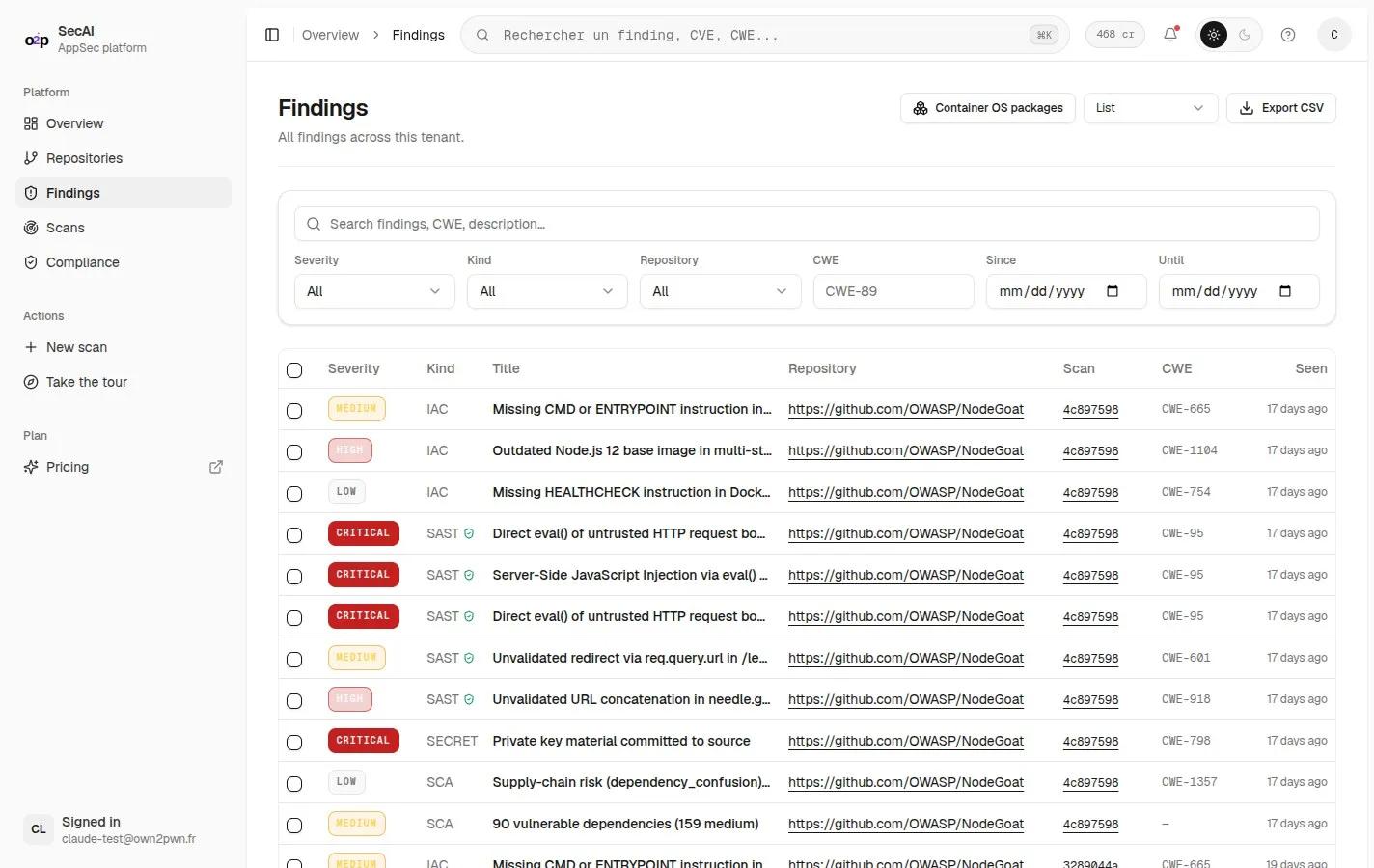
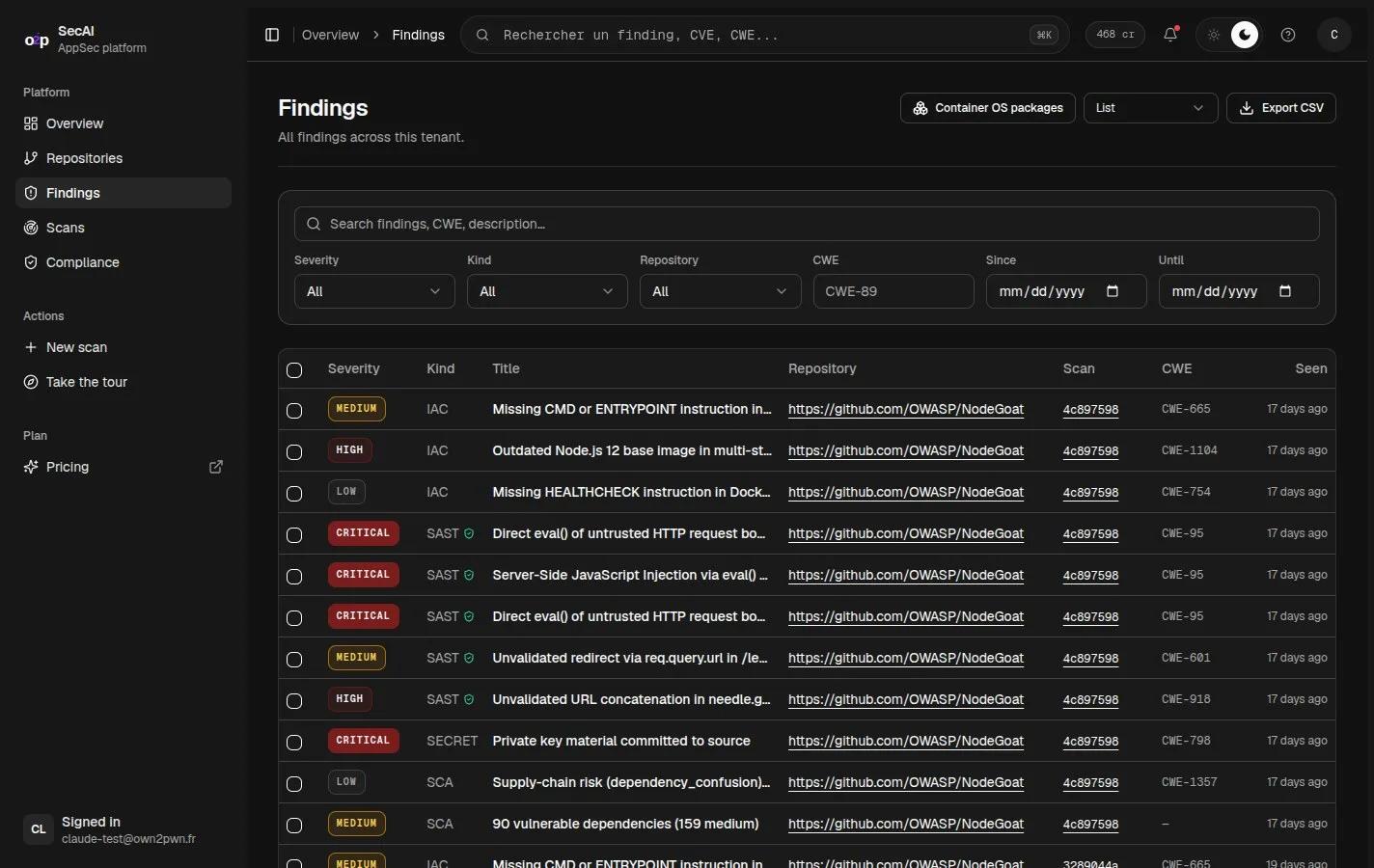
An agent that reasons about your code, not a SAST that matches patterns
A classic SAST compares your code to a library of patterns and hands you thousands of findings nobody reads. SecAI does the opposite: an agent chains SAST, SCA, secrets and IaC in one pass, follows the data flow to the sensitive sinks, then replays each chain to decide, exploitable or not. What doesn't hold up never gets surfaced. Your devs get a short, verified list, with the exploitation path and the fix.
- SAST · SCA · secrets · IaC, one pass
- 4 in 1
- in-depth taint analysis
- 14 languages
- CI Action, SARIF, fix in a PR
- GitHub
From exposed scan to delivered fix.
Six steps, two hands on the keyboard: the machine for pace, the pentester for proof. You don't get a list to triage, you get verified flaws, ranked by real risk.
- 01AI
Discover
The exposed surface mapped continuously: subdomains, services, ports, certificates, from a single domain.
- 02AI
Correlate
CVE intel and OSINT matched against your assets. We tie a vulnerable version to a service that's actually exposed, not to a line in an inventory.
- Human handoff
Where the scan tops out, the pentester takes over.
03HUMANValidate
The pentester replays the flaw by hand and clears out the false positives. This is where we find the exploitation chains and the business logic no scanner sees.
- 04AI + HUMAN
Prioritise
By proven risk, not off-the-shelf CVSS. Real exploitability, exposure, asset criticality: what can hit you first comes up first.
- 05HUMAN
Deliver
A two-level report: summary for leadership, technical detail and remediation for the devs. Every finding with its PoC.
- 06HUMAN
Retest
Once the fix is in place, we recheck. The finding only closes when the flaw no longer works. Retest included.
Service · Black-box pentest
We attack you like a stranger on the internet
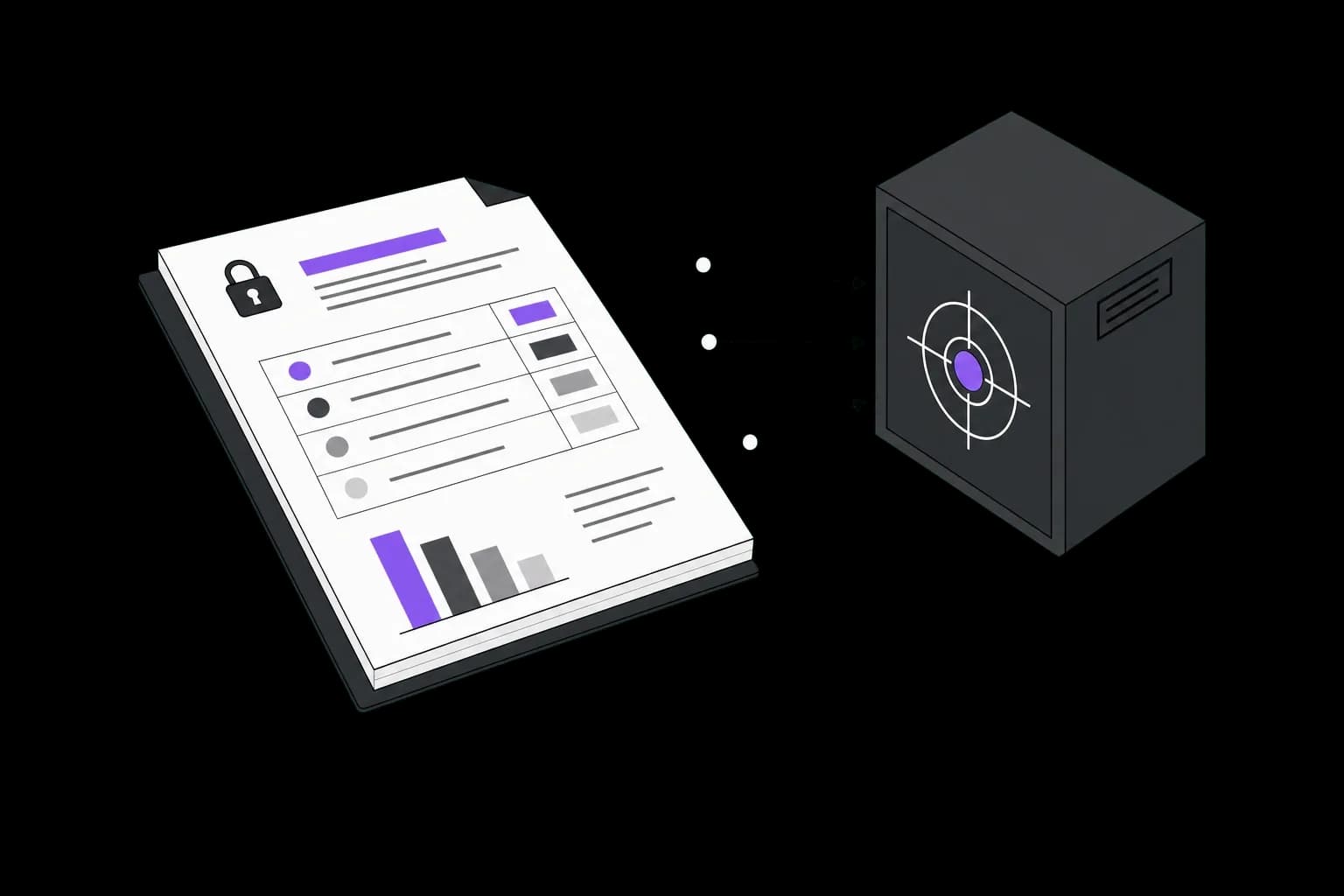
We start from your URL and nothing else: no code, no account, no docs. Exactly the position of someone trying to get in. We recon, we enumerate, we exploit the real attack paths through to impact. Every flaw we keep is exploited by hand, proven with a PoC, scored on CVSS, with the fix. A two-level report, leadership and devs, and the retest is included.
- certified consultant
- OSWE
- flaws exploited, proven
- PoC
- retest of the fixes
- included
Service · White-box pentest
What black-box will never see
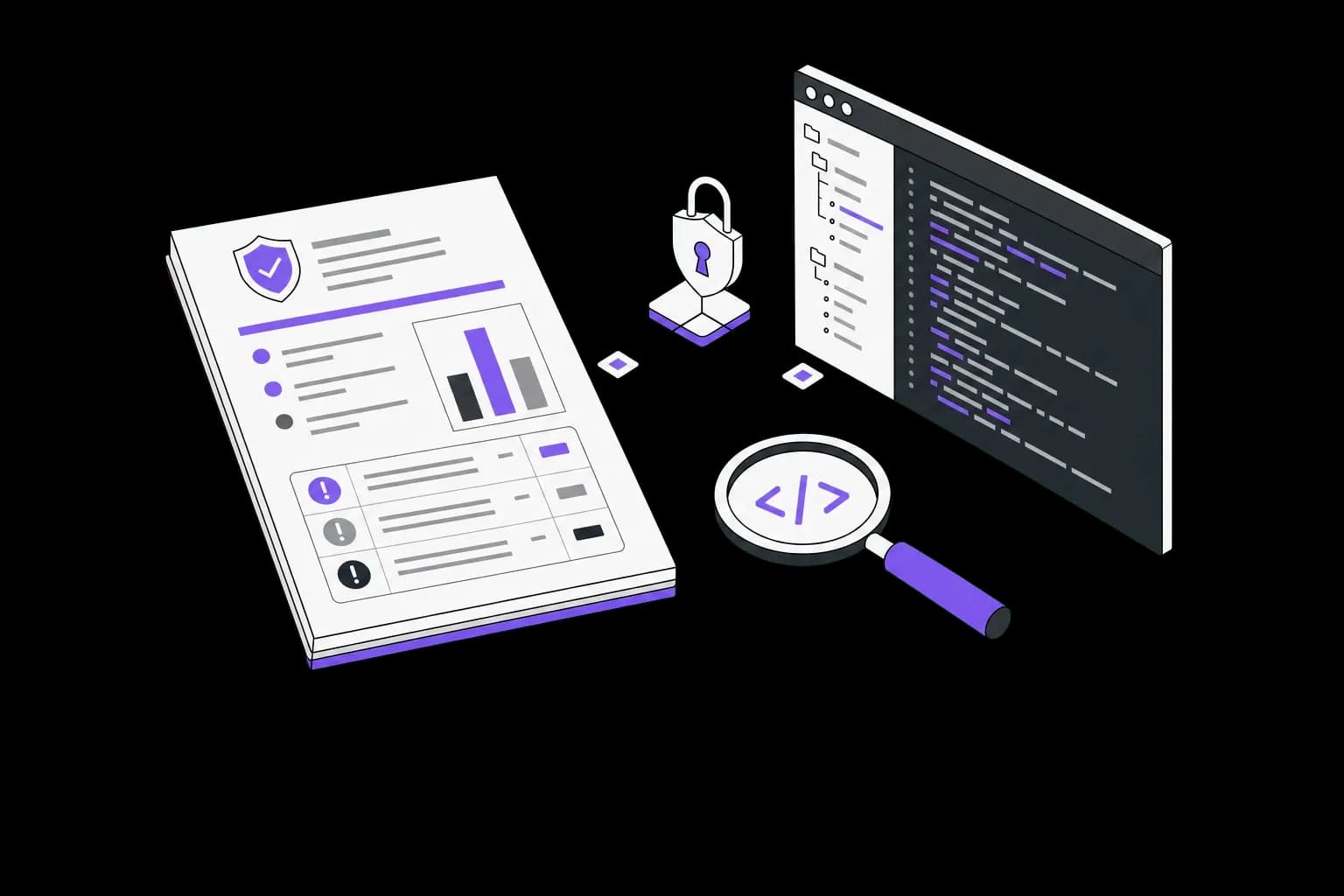
You open the Git repo and a pre-prod to us. We read the code like an attacker who already stole the repo: bypassable business logic, buried access controls, race conditions, crypto flaws. Everything that lives in a branch and never in an HTTP request. Manual review, SAST triaged by hand, exploitation guided by the source. Every flaw traced back to its cause, with the offending snippet and an example fix.
- certified consultant
- OSWE
- traced to the faulty code
- Cause
- read-only Git access, revocable
- NDA
Not three offers. One loop.
What a pentester finds by hand on an engagement, we turn into automated detection in EASM and the AI agent. And those tools widen, in turn, the ground the next pentest will dig into. That loop is our continuous offensive security.
The engagement feeds the platform
A flaw found by hand on an engagement becomes a check that then runs on your next scans. Your EASM inherits what a human understood.
The platform frames the engagement
Detection runs continuously on your external surface. The pentester doesn't attack blind: they start from where the machine has already chewed through the ground.
You get the exploitable
Not an unreadable scanner export. Verified flaws, ranked by risk, with the proof of exploitation. You fix, you don't triage.
A scanner alone drowns you in alerts. A firm alone comes by once a year. The loop never stops.
The pentest report that says what to fix, in what order, and how.
You get an actionable pentest report, not a scanner PDF. Every flaw is replayed by hand and delivered with its proof of exploitation (PoC), its CVSS score and the exact fix. Prioritised by real risk: you tackle line 1, not line 80.
- Every flaw with its proof of exploitation (PoC) replayed by hand
- CVSS score and severity, ranked by real risk first
- Precise remediation per finding, not a copy-pasted OWASP blurb
- Two-level report: leadership summary, technical detail for the devs
- Retest included once your fixes are in place
- Real-time dashboard, PDF / CSV / API exports
- OWASP & PTES methodology, from scoping to report
Penetration test report
ANONYMISED COMPANY
No critical flaw, but a chain rated high leads from a free trial account to administrator control of the instance. Fix expected before the next release.
Privilege escalation through mass assignment on the profile API
CVSS:3.1/AV:N/AC:L/PR:L/UI:N/S:U/C:H/I:H/A:H
PATCH /api/v1/users/me HTTP/1.1
Host: api.client-anonymise.example
Authorization: Bearer eyJhbGciOiJIUzI1NiIsInR5cCI6IkpXVCJ9.[...]
Content-Type: application/json
Content-Length: 37

{"displayName":"test","role":"admin"}HTTP/1.1 200 OK
Content-Type: application/json
Content-Length: 51
{"id":"u_2841","displayName":"test","role":"admin"}Request replayed by hand, token truncated, identifiers replaced.
Anonymised mock-up: an example of the deliverable format, with fictional data. No engagement report is ever published, and the name of a client is never disclosed.
No names on this site. That's the rule, not a gap.
NDA signed before the first scan. Scope in writing, dedicated access, least privilege, revoked at the end of the engagement. In offensive security, confidentiality isn't a sales option, it's the starting condition: we publish no logo, no reference, no report excerpt. Judge us on the method and on what we hand back, not on a wall of brands.
What you walk away with: an honest view of your exposure, and the prioritised list to reduce it.
NDA before the test
Confidentiality agreement signed before we touch anything. Your data is only used for the engagement.
Scoped access
Scope written in black and white, dedicated accounts, minimal rights, all revoked on delivery. Nothing out of scope.
Code never reused
Code analysed by SecAI is used only for the analysis. It never trains a model.
Restricted distribution
Encrypted report (CVSS, PoC), retest included, sent only to the people you name.
We write up what we break.
Our offensive security blog, without the gloss. Real flaws, taken apart step by step: how we find them, how we exploit them, how we close them. No filler, no rehashed CVE write-up. What our pentests and our EASM surface out in the field.
Penetration testing, pricing, compliance: what people ask us.
EASM or a penetration test: where do I start?+
Start with EASM if you first want to know what's exposed on the internet, from a single domain. Choose a penetration test if a specific application needs to be tested in depth. The two complement each other: EASM maps the external attack surface, the pentest digs in where it really counts.
How much does a web penetration test cost?+
The day rate is €450 for black-box and €600 for white-box. A black-box web pentest starts at €2,250 (5 days), a white-box at €3,000 (5 days), retest included in both cases. The scope sets the number of days, we frame it with you before quoting. Quote and reply within 24h, no mandatory sales call.
NIS2, DORA: is a penetration test mandatory?+
NIS2 requires you to regularly test the effectiveness of your security measures. DORA goes further for financial players, with resilience testing (TLPT) for the most critical entities. A documented penetration test, with a dated report and a retest, remains the most direct proof that you did it. We hand you a report an auditor can work from; we don't issue regulatory attestations or qualifications we don't hold.
Are your tests GDPR-compliant? Where does our data go?+
Hosted in the EU, data encrypted, access framed by NDA. We keep only what's needed for the audit and delete on request. For AI AppSec (SecAI), the code analysed is never used to train a model.
Is it intrusive? Can it break prod?+
EASM is passive: discovery is 100% external, no payload sent to your servers. The penetration test is framed with you (scope, time window, intensity) and nothing starts without your go-ahead. If production is sensitive, we work on a staging environment.
We already have a vulnerability scanner. Why you?+
A scanner lists known CVEs and leaves you to triage. We verify: the pentester replays the flaw, provides the PoC and the CVSS score. You only get the exploitable, with the proof. Fewer tickets to re-qualify, more fixes that matter.
Start free, or request a pentest quote.
Try EASM for free
Create a free account, give us a domain. EASM maps what you expose to the internet (subdomains, IPs, APIs) and ranks it by risk. You see your external attack surface with no sales call.
Request a pentest quote
Describe your web scope and your constraints. An OSWE consultant calls you back with a concrete attack approach, a timeline and a costed quote. Not a sales pitch.
Give us a scope.
We send back what breaks.
EASM demo, web pentest quote or a technical question: you describe your scope, we come back within 24 h with a concrete approach. On the other end, a pentester, not a salesperson.