EASM
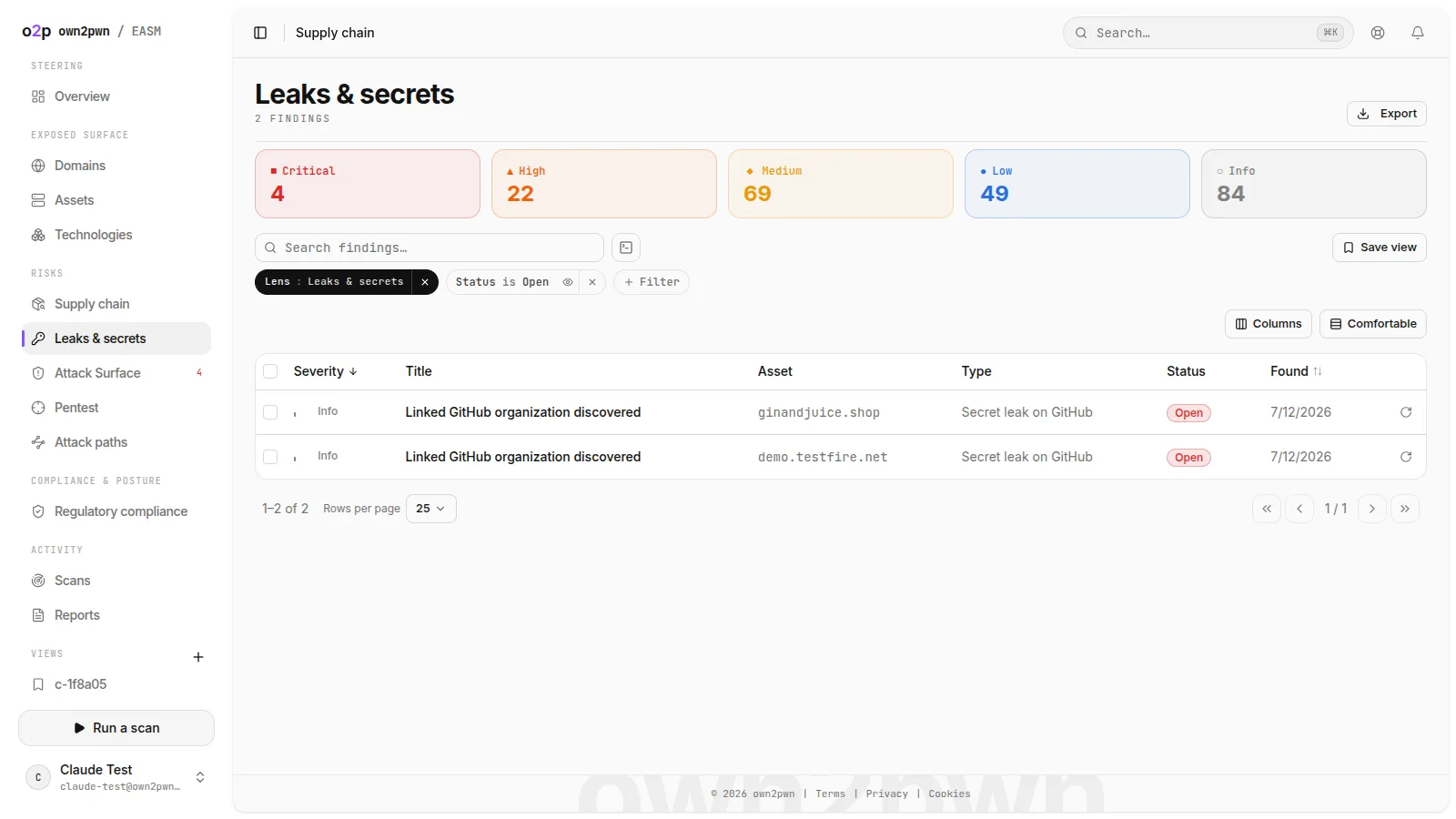
Leaks & Secrets
Your exposed secrets, caught before an attacker uses them.
An API key left in a public Git repo, an open S3 bucket, a .env file served in clear: those are doors already open. We start from your root domain, pull up the repos, buckets and files exposed across your surface, flag the secrets that leaked and mask their value before writing anything. Continuously, not once a year.
- in, the exposed secrets out
- 1 domain
- repos, buckets and files put through the checks
- Git, cloud, .env
- continuous monitoring, not a one-off scan
- 24/7
Features
What leak detection goes looking for.
Secrets exposed in Git repositories
API keys, tokens, database credentials and infra secrets left in a public repo or a code leak tied to your domain. The engine surfaces those exposed repos and flags the secrets sitting in the code, the commit history and config files versioned by mistake.
Open cloud buckets (S3, Azure, GCP)
Public S3 buckets, Azure Blob Storage, GCP Storage open to anyone. Dedicated modules check storage ACLs and flag endpoints vulnerable to SSRF, which can be used to reach cloud metadata. A bucket reachable from the Internet and tied to your domain surfaces in the inventory, along with what it lets leak.
Accessible .env files, configs and artifacts
A .env served in clear by a misconfigured server, a forgotten backup, an exposed config file, a public build artifact: each is a source of secrets a request away. Every discovered asset is tested for these sensitive files left accessible without authentication.
Secrets masked before they are written
A found secret is never stored in clear. Its value is masked before it is written to the database: you know a key leaked, where, and of what type, without the platform keeping the exploitable secret. That is the default behaviour, not an option to enable.
Leaks and secrets detection pricing.
Discovery
€0
- Leaks & Secrets module included in the EASM offering
- In plain terms: the perimeter of a single domain name, 25 exposed assets at most.
- 10 scans / mo
- Multi-source discovery + more than 7,800 security checks
- CVE correlation and prioritisation by real exploitability
- 2 AI-native validations / mo
- Email alerts, 1 user
- Free, no time limit and no credit card
Pro
€99 / mo
- In plain terms: 5 domain names, 250 tracked exposed assets, 5 people on the account.
- 100 scans / mo
- 30 AI-native validations / mo
- HMAC-signed webhooks (Slack, Teams, Discord, PagerDuty)
- Jira, GitHub, GitLab, Slack integrations
- PDF and CSV exports, API access (5 keys)
For businesses only, a company identifier is asked at the next step.
Business
€299 / mo
- In plain terms: 15 domain names, 1,000 tracked exposed assets, no cap on scans.
- 100 AI-native validations / mo
- SSO, RBAC and role management
- SIEM connector, custom integrations
- Email support, prioritised handling
For businesses only, a company identifier is asked at the next step.
Enterprise
On request
- In plain terms: the perimeter you set in the contract, no cap on domains or validations.
- SSO / SAML, SCIM provisioning
- Enhanced AI validation (extended reasoning)
- GDPR-compliant DPA, master agreement and NIS2 guidance
- A single point of contact: the pentester who runs it
VAT not applicable (art. 293 B of the French tax code)
How it works
From setup to the first alert.
- 01
You enter a domain
A single root domain name in, for example acme.com. No agent to install, no cloud access to connect, no token to provide. The scan starts right away and the scope stays under your control: we follow the chain from what you declare, no reckless attribution of repos or buckets that aren't yours.
- 02
We pull up exposed repos, buckets and files
From that domain, discovery rebuilds your surface (subdomains, IPs, services, cloud storage), then every asset runs through the secret-exposure checks: tied public Git repos, S3/Azure/GCP buckets and their ACLs, accessible .env files and configs, overly talkative endpoints, endpoints vulnerable to cloud SSRF. Anything that leaks a secret surfaces in the inventory.
- 03
Risk triage, then AI validation on critical cases
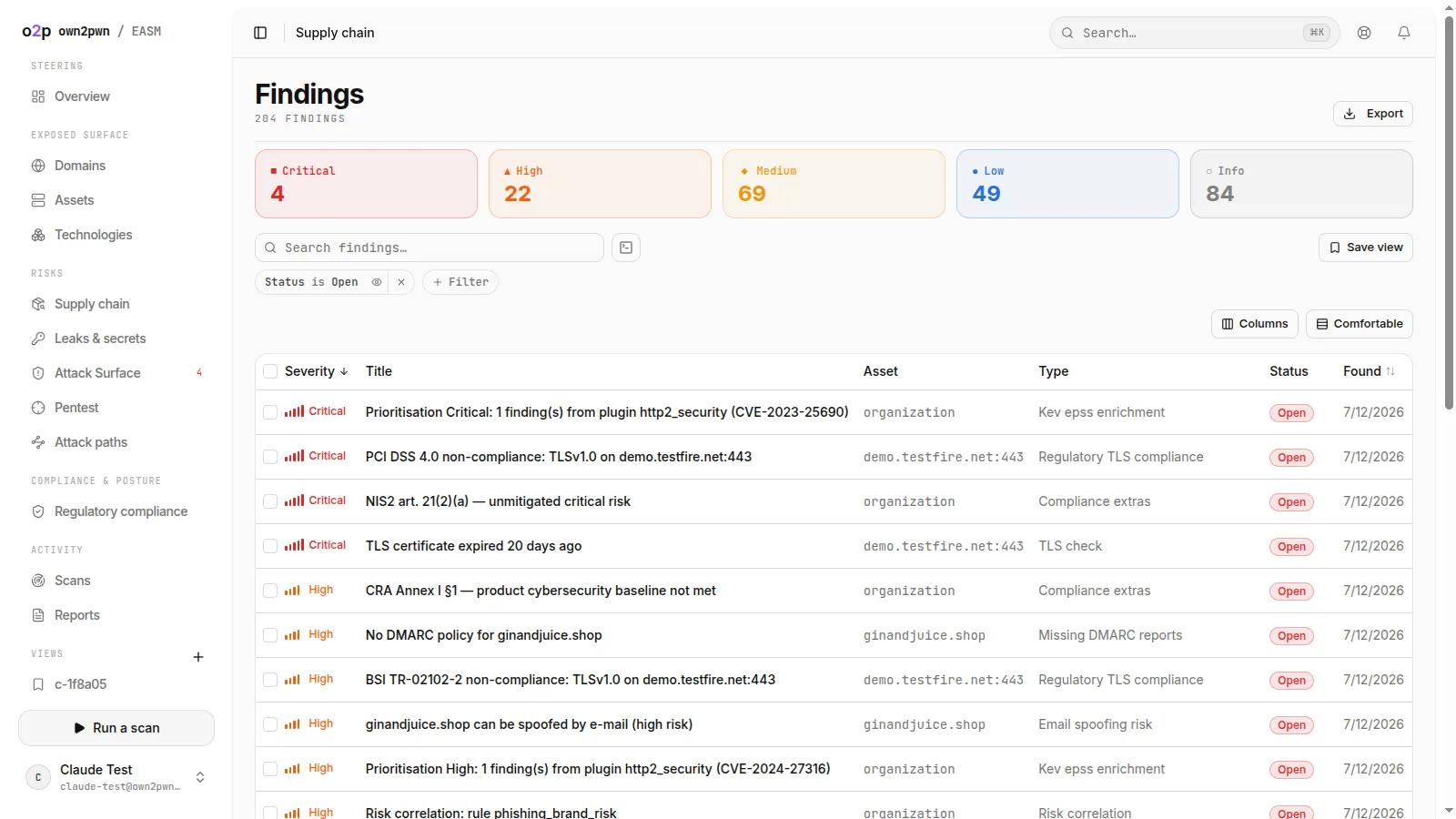
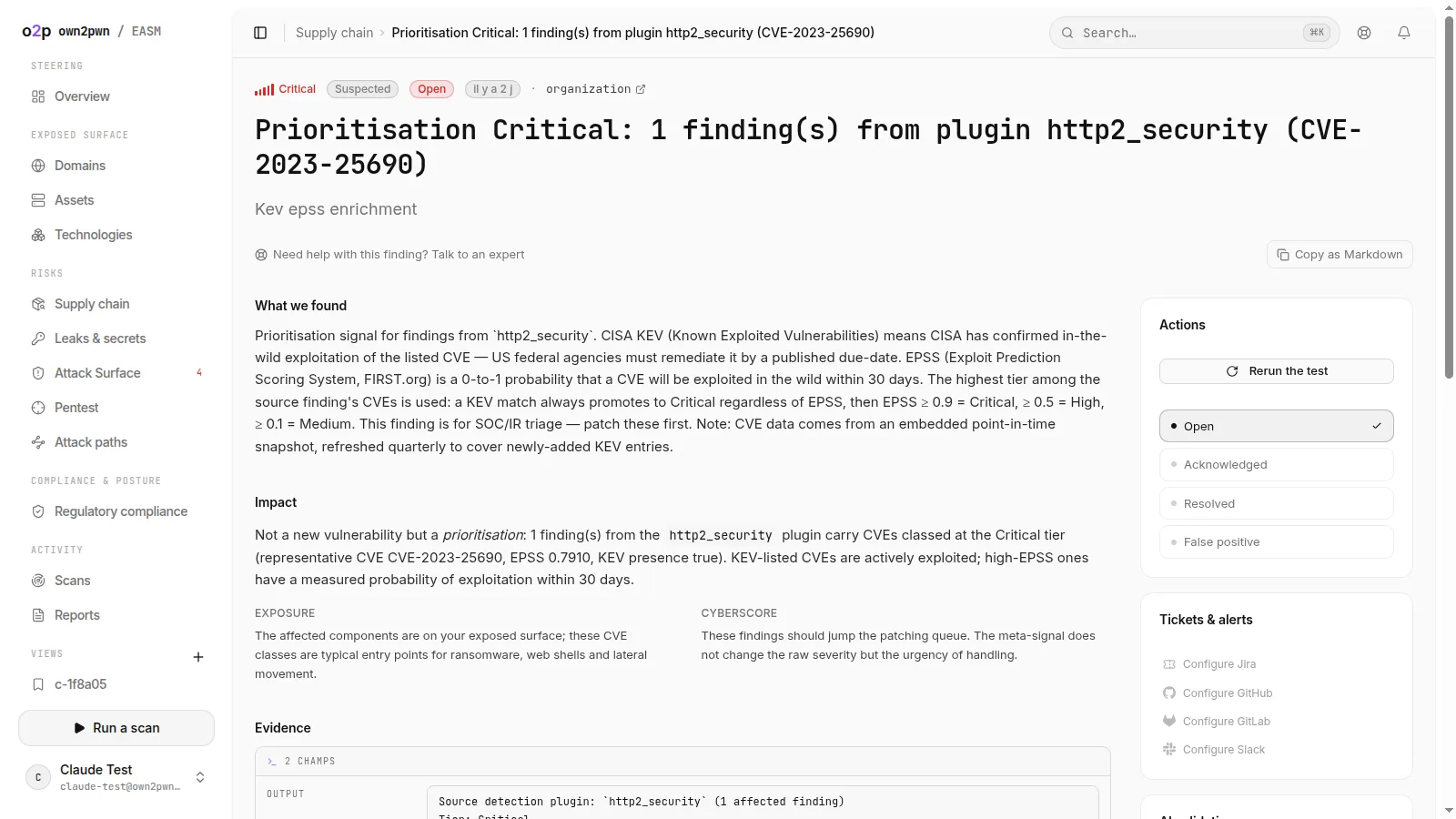
Findings are ranked by real risk, not dumped in a pile: an active cloud secret doesn't weigh like an expired test token. On High and Critical findings from a verified domain, you can trigger AI-native validation: an autonomous agent tries to confirm exploitability, its tooling running inside an ephemeral sandbox with filtered network egress, and keeps a proof with secrets masked. It is AI, not a pentester, and it is quota-limited (30 validations a month on Pro). We lower the noise, we don't promise zero false positives.
- 04
Continuous monitoring, an alert on the first exposed secret
Secrets don't leak just once: a new commit, a new cloud migration, a reconfigured server, and a value goes back into the wild. Scans run continuously and on demand, change detection flags every new secret or bucket flipped to public, and the alert lands the same day in Slack, Teams, Jira, GitHub, PagerDuty or a signed webhook.
Benefits
What a secret found before the attacker saves you.
Find what leaked before the attacker does
An exposed secret gives no warning. The key left in a commit, the bucket opened during a migration, the .env served by a misconfigured server: they sit on your surface until someone picks them up. We start from a single root domain and pull up the exposed repos, buckets, files and endpoints tied to your perimeter, where an attacker looks first. Every new scan compares the state to the previous one: a secret that appeared, a bucket gone public, a config file newly accessible surfaces on its own.
One exposed secret is a key that opens the rest
An API key unlocks a service, a token opens a session, a database credential frees up data. A single leaked secret can be enough to pivot into your infra. That is why these findings are taken seriously in prioritisation: an active cloud secret ranks ahead of a theoretical CVSS hidden behind a WAF. The graph links the asset where the secret leaks to the rest of your surface, to see what falls behind if someone uses it.
The leak handled without ever copying the secret in clear
Detecting a secret raises a problem: not leaking it again by storing it. The secret's value is masked before it is written to the database; the platform keeps the fact, the type and the location, not the exploitable secret. You have enough to act (revoke, rotate the key, close the bucket) and enough to hand to an auditor, without a database dump replaying the leak. Data hosted in the EU, under European law, designed by an OSWE-certified pentester.
Overview
The platform in pictures.
Why own2pwn
Why this detection does not drown the team in alerts.
The secret is never stored in clear
Most scanners happily copy the found secret into their own store: once detected, it leaks a second time. Here, the value is masked before it is written. You know a key leaked, of what type and where, without the platform keeping the exploitable secret. A database dump does not replay the leak.
Hosted in the European Union
Your exposed secrets, even masked, and the map of your leaks stay under European law: hosted in the EU, GDPR compliant, with strict per-customer isolation at the database level. Handing the inventory of your leaks to a US vendor exposes it to extraterritorial access requests.
Designed by an OSWE-certified pentester
The logic follows what an attacker looks for first: the public repo, the open bucket, the forgotten .env, the talkative endpoint. Prioritisation reflects a secret's real exploitability, not a generic score. It is an offensive method turned into SaaS, not a compliance checklist copied from a framework.
Continuous, not a one-off Git scan
A secrets audit once a quarter leaves a wide-open window: the key that leaks the next day stays exploitable for months. Detection runs continuously and on the first change, flagging the secret as soon as it appears. The discovery scan stays non-intrusive, built to run on production without coordinating a maintenance window.
Frequently asked questions
Your questions about leaks and secrets detection.
What kinds of secrets do you detect?
How do you find an exposed Git repo tied to my domain?
Do you detect open cloud buckets (S3, Azure, GCP)?
Is the found secret stored in clear on your side?
How is this different from a secret scanner like gitleaks or trufflehog?
What does AI validation confirm on an exposed secret, and what are its limits?
How often is my surface re-scanned for leaks?
How does leak detection help my NIS2 compliance?
Is there a minimum term, and how do I cancel?
Do I need a credit card for the free plan?
How long between payment and actual access?
Can I change plan mid-subscription?
Can an endpoint leak a secret without it sitting in a file?
Where does the alert land when a new secret shows up?
Go further
Asset discovery in practice
Subdomain enumeration, ASN, ports and cloud assets to map your surface.
Read →Finding exposed shadow IT
Tracking down the exposed assets nobody manages.
Read →The NIS2 directive and Article 21
Who is in scope, the 10 Article 21 measures, and why an inventory of what you expose underpins them.
Read →A secret lying around somewhere?
Detection starts from your root domain. To talk it through first, a reply lands within 24 hours.