EASM
AI-Native Pentest (AI-PTaaS)
EASM's AI-native validation, an autonomous agent that tries to exploit your critical findings.
On a High or Critical finding from a verified domain, you trigger an autonomous agent that tries to confirm exploitability with real offensive tooling (sqlmap, nuclei and others), run inside an ephemeral container with filtered egress. Bounded, quota-limited, honest: it is AI, not a human pentester, and it does not promise zero false positives.
- only the findings that matter, on a verified domain
- High / Critical
- strict guardrails, 150,000 tokens per finding
- 20 steps · 300 s
- validations a month depending on the EASM plan
- 2 to unlimited
Features
What the agent attempts to confirm a flaw.
An autonomous agent that tries to exploit
Not a chatbot, not a second scan pass. On a critical finding, the agent reasons, chooses its actions and chains steps to prove the vulnerability is actually exploitable, not merely plausible from the banner. If it succeeds, the finding moves to confirmed; otherwise it stays at detected.
Real offensive tooling, not a simulation
The agent has the same tools a human operator would use: sqlmap for SQL injection, nuclei for exploitation templates, and the rest of the kit depending on the finding. It runs them for real against the affected asset. That is what separates a confirmation of exploitability from a CVE correlation.
Bounded and quota-limited by design
Every validation runs under strict guardrails: 20 steps maximum, 300 seconds, 150,000 tokens per finding. The agent doesn't spiral, doesn't roam beyond the targeted asset and stops dead at the limit. Volumes are quota-limited per month: 2 on Discovery, 30 on Pro, 100 on Business, unlimited on Enterprise.
An ephemeral sandbox with filtered egress
The tooling runs in a throwaway container, created for the validation then destroyed. Its network egress is filtered to the target's public IPs only: it can't bounce elsewhere, nor pivot into your internal network. The sandbox isolates the tooling, not your asset: the test stays active on the target, but the agent's reach is walled off.
AI-native pentest pricing.
Discovery
€0
- AI-Native Pentest module included in the EASM offering
- In plain terms: the perimeter of a single domain name, 25 exposed assets at most.
- 10 scans / mo
- Multi-source discovery + more than 7,800 security checks
- CVE correlation and prioritisation by real exploitability
- 2 AI-native validations / mo
- Email alerts, 1 user
- Free, no time limit and no credit card
Pro
€99 / mo
- In plain terms: 5 domain names, 250 tracked exposed assets, 5 people on the account.
- 100 scans / mo
- 30 AI-native validations / mo
- HMAC-signed webhooks (Slack, Teams, Discord, PagerDuty)
- Jira, GitHub, GitLab, Slack integrations
- PDF and CSV exports, API access (5 keys)
For businesses only, a company identifier is asked at the next step.
Business
€299 / mo
- In plain terms: 15 domain names, 1,000 tracked exposed assets, no cap on scans.
- 100 AI-native validations / mo
- SSO, RBAC and role management
- SIEM connector, custom integrations
- Email support, prioritised handling
For businesses only, a company identifier is asked at the next step.
Enterprise
On request
- In plain terms: the perimeter you set in the contract, no cap on domains or validations.
- SSO / SAML, SCIM provisioning
- Enhanced AI validation (extended reasoning)
- GDPR-compliant DPA, master agreement and NIS2 guidance
- A single point of contact: the pentester who runs it
VAT not applicable (art. 293 B of the French tax code)
How it works
From setup to the first alert.
- 01
A critical finding on a verified domain
Validation only opens on High and Critical findings, and only for a domain whose ownership you have proven. No magic button on any URL on the web: the scope stays yours. The rest of your surface keeps being mapped by the non-intrusive EASM scan, as usual.
- 02
You trigger the validation, by hand
Because it's active testing, nothing fires on its own. You pick the finding, you launch the validation from the interface. The action spends one credit of your monthly quota (2 on Discovery, 30 on Pro, 100 on Business, unlimited on Enterprise), shown in real time.
- 03
The agent attempts exploitation in a sandbox
An ephemeral container with filtered egress starts up. The agent reasons about the finding, picks its tooling (sqlmap, nuclei and others), runs it against the affected asset and observes the result to adjust the next step. All of it under guardrails: 20 steps, 300 seconds, 150,000 tokens. At the limit, it stops, whatever the progress.
- 04
Confirmed with proof, or left at detected
If exploitation succeeds, the finding moves to confirmed and carries a redacted proof (secrets masked) you can review and share. Otherwise it stays at detected: the agent didn't prove exploitability, which doesn't mean it's impossible. We don't overread a failure into a false positive, and we never promise zero false positives.
Benefits
What proof of exploitability changes for your teams.
Lower the noise on your critical findings
A scanner hands you a list of probable vulnerabilities, correlated to the banner and version. Useful, but you don't know which ones actually lead somewhere. AI-native validation takes your High and Critical findings and actually attempts exploitation: what is confirmed surfaces with its proof, the rest stays at detected. You handle what is proven exploitable first, not what looks bad on paper. We don't promise zero false positives; we save you the most expensive triage.
It's bounded AI, and we own what it is
This agent is artificial intelligence, not a human pentester. It doesn't replace the judgement of an OSWE-certified operator on a complex exploitation chain, a business authentication bypass or twisted application logic. It does one thing and it does it under guardrails: confirm, or not, that a critical finding is exploitable with standard tooling. Thorough human verification is our pentests, a separate offering.
Active validation, hosted in the EU
Unlike the EASM scan, which is non-intrusive by design, validation is active testing: it runs real tooling against the live asset, which can change its state. That's why it is manual, reserved for critical findings on a domain you have verified, and quota-limited. The models run in a European region via Vertex AI, with no training on your data, and your proofs stay isolated per account under European law.
Overview
The platform in pictures.
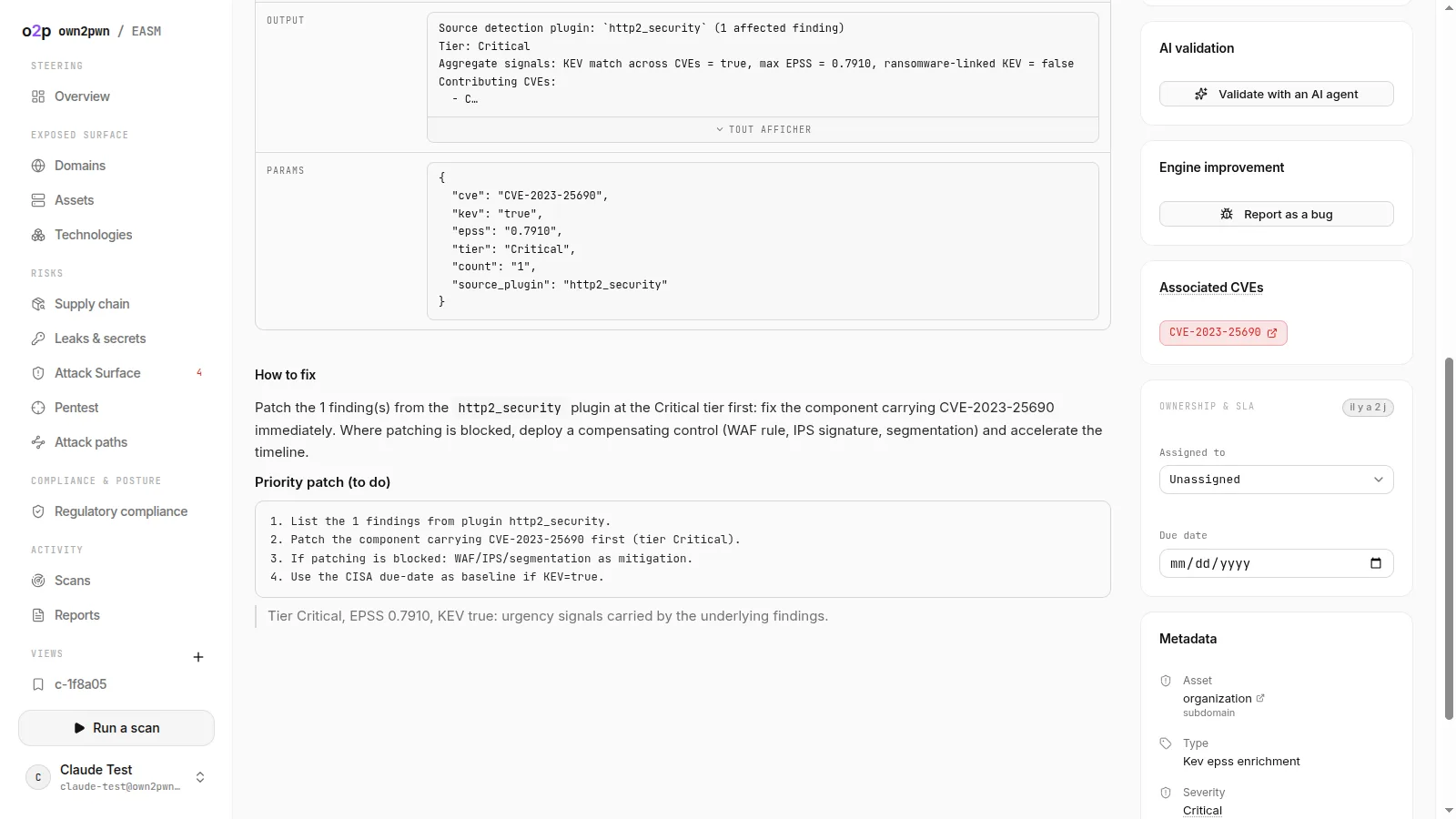
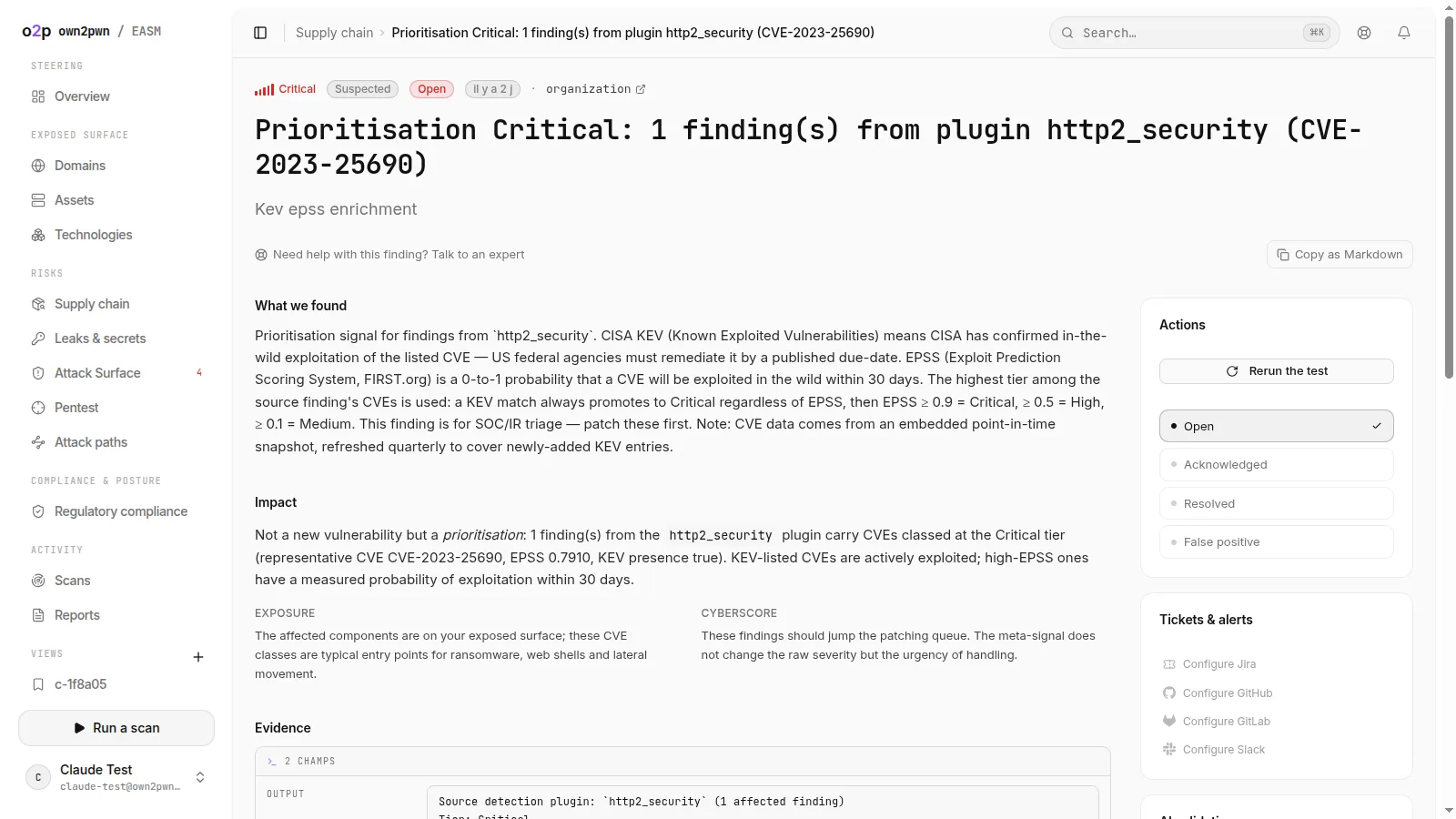
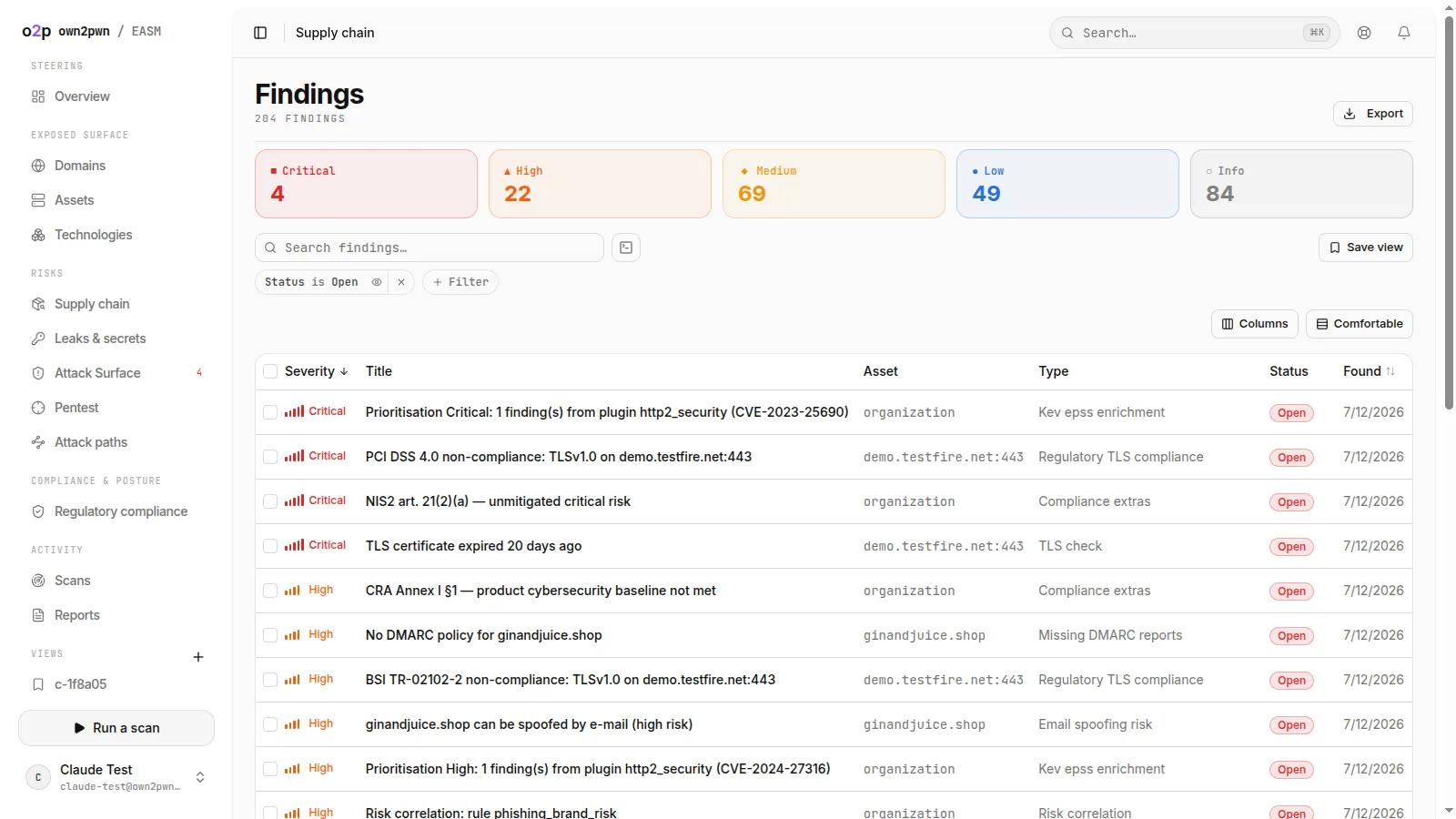
Why own2pwn
Why an agent, and where its abilities stop.
It is AI, not a human pentester
We say it in plain words because the market loves to blur the line. This agent confirms the exploitability of critical findings with standard tooling, under guardrails. It doesn't do twisted business logic, no creative exploitation chain, no human judgement on context. For that, there are our pentests, run by an OSWE-certified operator.
Active testing owned, not a scan in disguise
The EASM scan is non-intrusive and runs on production without taking it down. Validation, on the other hand, executes real exploits against the live asset and can change its state. We don't hide that difference behind reassuring vocabulary: it is manual, reserved for critical findings on a verified domain, quota-limited, isolated in a sandbox.
Real guardrails, not decorative ones
20 steps, 300 seconds, 150,000 tokens per finding, network egress filtered to the target's public IPs, container destroyed after use. These bounds are the hard limits the agent operates within.
Hosted in the European Union
Anthropic's Claude models are called through Google Cloud Vertex AI in a European region, under standard contractual clauses, with no training on your data. Your findings, your proofs and the rest of your inventory stay under European law, isolated per account. Handing an exploitability proof to a US vendor exposes it to extraterritorial access requests; ours stays hosted in the EU.
Frequently asked questions
Your questions about AI-native pentesting.
Is AI validation intrusive?
How is this different from a human pentester?
Where do the AI models run, and on what data?
Does it promise zero false positives?
What tools does the agent actually use?
How is a validation triggered, and on what?
What are the validation quotas per plan?
What happens if the agent hits one of its limits?
Is there a minimum term, and how do I cancel?
Do I need a credit card for the free plan?
How long between payment and actual access?
Can I change plan mid-subscription?
What is kept as evidence after a validation?
Proof rather than an alert?
The agent works on a verified domain, within a monthly quota. For a human pentest, a reply lands within 24 hours.